Systematic Review in Chinese Neurosurgical Journal Examines Rare Tumor Bleeding
Review identifies reported symptoms, bleeding-related risk factors, and management strategies BEIJING, CHINA, August
Press Release Disclaimer: This is a press release distributed through the XPR Media network. It has not been independently verified by our newsroom.
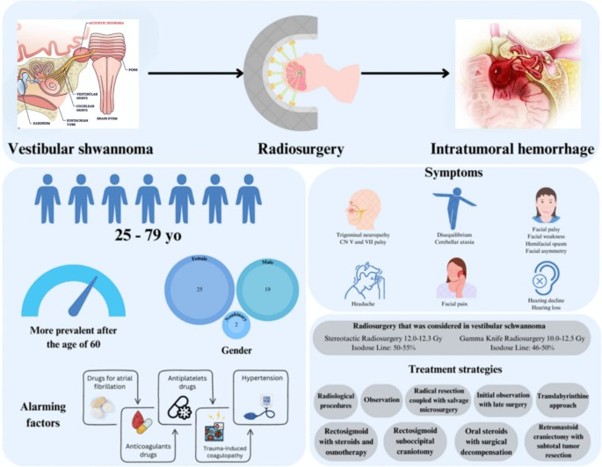

Review identifies reported symptoms, bleeding-related risk factors, and management strategies
BEIJING, CHINA, August 10, 2026 /EINPresswire.com/ — Vestibular schwannomas, also called acoustic neuromas, are benign tumors that arise from the vestibulocochlear nerve and can affect hearing and balance. Typical symptoms include one-sided hearing loss, tinnitus, vertigo, and, as tumors enlarge, facial weakness or altered sensation. Depending on tumor size, growth, symptoms, and patient preference, management may involve surveillance, microsurgery, or stereotactic radiosurgery. Radiosurgery can control tumor growth without open surgery, but clinicians must remain alert to rare complications.
One such complication is intratumoral hemorrhage, or bleeding within the tumor. Although uncommon, it can cause sudden neurological deterioration and may require urgent intervention. To better understand this rare complication, an international team of researchers, including Dr. Bipin Chaurasia, systematically reviewed published reports of intratumoral hemorrhage occurring after radiosurgery for vestibular schwannoma. This systematic review was published in Volume 12 Article 18 of the Chinese Neurosurgical Journal in June 2026. “Although intratumoral hemorrhage following radiosurgery is rare, clinicians should recognize that it may occur long after treatment and that management should be individualized according to each patient’s clinical presentation, tumor characteristics, and overall condition”, exclaimed Dr. Chaurasia, corresponding author of the study.
The review followed PRISMA 2020 guidance and was registered in PROSPERO. The researchers searched PubMed, Google Scholar, the Cochrane Library, Embase, Web of Science, and Scopus for English-language reports available through January 2024. Eleven eligible studies, largely case reports and small case series, described 47 patients who developed intratumoral hemorrhage after stereotactic radiosurgery or Gamma Knife radiosurgery. Because the reports differed substantially in design, follow-up, and outcome definitions, the authors used a qualitative narrative synthesis rather than a meta-analysis. Patients ranged from 25 to 79 years of age, with cases clustering in the sixth decade and older. Some patients had identifiable bleeding-related factors. These included uncontrolled hypertension, antiplatelet therapy, anticoagulant use, coagulopathy, and trauma-associated clotting abnormalities. The review does not establish how strongly these factors predict hemorrhage, but suggests they should be carefully considered alongside each patient’s medical history and medication use before and after treatment.
Clinical presentation varied widely. Trigeminal neuropathy and disequilibrium were among the most frequently reported symptoms. Other presentations included facial weakness or sensory loss, cerebellar ataxia, headache, hearing decline or loss, facial pain, cranial nerve palsies, and hemifacial spasm. Symptom onset ranged from days to years after radiosurgery, indicating that complications may not be confined to the immediate post-treatment period.
Management depended on the severity and evolution of the hemorrhage. Some patients underwent observation with serial imaging, while others required steroids, surgical decompression, subtotal or radical tumor resection, or other neurosurgical procedures. Approximately half of the patients experienced outcomes that the original study authors classified as favorable using non-standardized outcome definitions, while two deaths were reported. The authors emphasize that these descriptive findings should not be interpreted as population-level estimates because the available evidence is limited and highly heterogeneous.
The findings reinforce the need for personalized follow-up after radiosurgery. New or worsening hearing loss, vertigo, imbalance, facial symptoms, headache, or other neurological changes should prompt timely clinical assessment and imaging. “This review highlights the considerable variability in patient presentations and outcomes. Treatment decisions should therefore be guided by tumor characteristics, symptom severity, individual patient factors, and multidisciplinary clinical judgment rather than a single management approach,” explains Dr. Chaurasia.
The authors note that the available evidence is of very low certainty because it is based mainly on isolated case reports and small case series. They call for larger prospective studies with standardized reporting to better define the risks and management of this rare complication.
Reference
Title of original paper: Intratumoral hemorrhage in vestibular schwannomas post-radiosurgery: a systematic review
Journal: Chinese Neurosurgical Journal
DOI: https://doi.org/10.1186/s41016-026-00439-5
About Chinese Neurosurgical Journal
The Chinese Neurosurgical Journal is an international, peer-reviewed, open-access journal dedicated to advancing clinical practice and research across all areas of neurosurgery. As the official journal of the Chinese Neurosurgical Society, it publishes cutting-edge studies on neurosurgical techniques, neuro-oncology, cerebrovascular disease, trauma, spinal disorders, and emerging neuroscience trends. The journal emphasizes clinically relevant innovations that improve patient outcomes, surgical decision-making, and multidisciplinary care worldwide. Indexed in major databases including PubMed Central, Scopus, and DOAJ, it ensures high visibility and accessibility for global researchers and clinicians while promoting collaboration, education, and knowledge exchange across disciplines in neurological science.
Website: https://cnjournal.biomedcentral.com/
About Neurosurgery Clinic, Birgunj Health Care (BHC) Hospital, Nepal
The Neurosurgery Department at Birgunj Health Care (BHC) Hospital, Birgunj, provides specialized surgical care for disorders of the brain, spine, and nervous system. The department offers comprehensive evaluation and treatment for conditions including stroke, aneurysms, brain and spinal disorders, epilepsy, movement disorders, and peripheral nerve diseases. Supported by modern technology and minimally invasive surgical techniques, it also provides neurorehabilitation and 24/7 emergency neurosurgical services. The department is committed to delivering advanced, patient-centered care while improving neurological health outcomes in the region.
Website: https://bhchospital.com/neuro-surgery/
About Dr. Bipin Chaurasia from Neurosurgery Clinic, Nepal
Dr. Bipin Chaurasia, MS (Neurosurgery), is a neurosurgeon affiliated with the Neurosurgery Clinic in Birgunj, Nepal, and the College of Medical Sciences in Bharatpur. His clinical and academic interests include neurotrauma, spinal and skull base surgery, global neurosurgery, and digital education for neurosurgical professionals. He serves on the World Federation of Neurosurgical Societies Web and Publication Committee and has authored numerous peer-reviewed publications. He also contributes to international research collaborations and promotes the use of digital platforms to advance neurosurgical education, research, and clinical practice worldwide.
Funding information
Not applicable.
Yi Lu
1059978478 ext.
luyi617@sina.cn
Chinese Neurosurgical Journal
Legal Disclaimer:
EIN Presswire provides this news content “as is” without warranty of any kind. We do not accept any responsibility or liability
for the accuracy, content, images, videos, licenses, completeness, legality, or reliability of the information contained in this
article. If you have any complaints or copyright issues related to this article, kindly contact the author above.

Media gallery