Far-field Wi-Fi-band bioelectronics speeds wound repair and connected care
GA, UNITED STATES, November 23, 2026 /EINPresswire.com/ -- A wireless, battery-free bioelectronic system can harvest
Press Release Disclaimer: This is a press release distributed through the XPR Media network. It has not been independently verified by our newsroom.
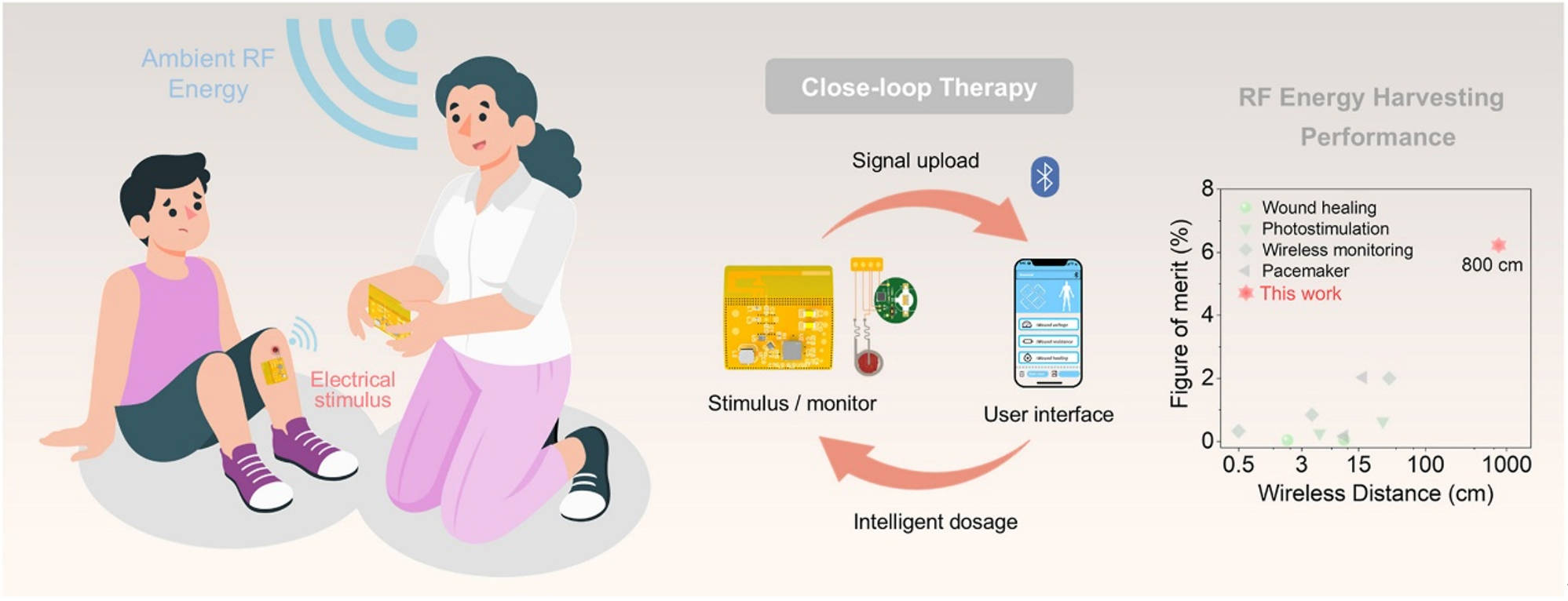

GA, UNITED STATES, November 23, 2026 /EINPresswire.com/ — A wireless, battery-free bioelectronic system can harvest far-field radiofrequency (RF) energy in the Wi-Fi band to deliver electrical stimulation and monitor wound status, offering a closed-loop-capable approach to tissue repair. The platform pairs stretchable molybdenum (Mo)-based composite electrodes with low-power sensing electronics and a smartphone interface, avoiding tethered power and surgical retrieval. In mouse full-thickness wounds, the system improved closure and supported collagen deposition, blood-vessel formation and hair-follicle regeneration. Transcriptomic analysis showed reduced inflammatory signaling alongside activation of regenerative and metabolic programs. The work outlines a scalable path toward self-powered bioelectronic medicine, connected wound care and at-home regenerative therapy.
Skin wounds caused by trauma, surgery or disease remain a major clinical burden, particularly when diabetes or vascular disease delays healing. Conventional debridement, closure and dressings support repair but do not actively direct the wound microenvironment. Endogenous electric fields help guide keratinocyte migration, angiogenesis and tissue remodeling, inspiring external electrical stimulation therapies. Yet many bioelectronic systems rely on near-field wireless power, precise alignment and short transmission distances, or they need batteries and retrieval. These constraints limit continuous, user-friendly care and complicate home use and long-term monitoring. Given these challenges, in-depth research on long-range, battery-free and closed-loop bioelectronic wound therapy is needed.
Researchers from Shanghai Jiao Tong University School of Medicine, with collaborators at Southwest University, the University of Wisconsin–Madison, Shanghai Ninth People’s Hospital and The Australian National University, reported (DOI: 10.1016/j.esci.2025.100514) the platform online Nov. 2026 in eScience. The study describes a far-field radiofrequency (RF)-powered, battery-free device that combines stretchable molybdenum (Mo)-based electrodes, impedance sensing and a smartphone interface. The team tested it in a mouse full-thickness excisional wound model and examined tissue and transcriptomic responses to daily stimulation.
The device uses an inverted-F antenna and power-management circuit to convert Wi-Fi-band RF signals into direct current, operating beyond 8 m and reducing the alignment constraints of near-field links. A ring-shaped polyvinyl alcohol (PVA)–Mo composite electrode surrounds the wound and delivers a localized electric field; the same electrodes support intermittent impedance measurements that are sent wirelessly to a smartphone. The electrodes remained thermally safe during stimulation and detached naturally with the scab, avoiding retrieval. In mice, daily stimulation accelerated wound closure and improved granulation tissue, collagen density, vascularization and hair-follicle regeneration. Ribonucleic acid (RNA) sequencing showed downregulation of inflammatory mediators and chemokines, including Il6, Ccl2, Ccl20 and Cxcl5, and upregulation of keratin genes such as Krt10, consistent with suppressed inflammation and activated regeneration. The platform maintained stable output under bending and at wound-relevant impedance levels, supporting flexible use. Thermal imaging and cell studies indicated safe operation, with high fibroblast viability. Biocompatibility tests showed no histological abnormalities in major organs, and the team says impedance data could help track healing progression. The device also showed stable electrical behavior when hydrated and under mechanical deformation, important for conforming to moving tissue.
The authors said the platform’s strength lies in combining energy autonomy, long-range operation and feedback in one wound-contacting system. They said the electrodes are designed to conform to tissue, remain thermally safe and leave no retrievable component as healing proceeds. According to the team, impedance data could eventually help tune stimulation to different healing stages rather than applying a fixed dose. They cautioned that the demonstration used a dedicated RF source and that larger animal studies are needed to optimize voltage, frequency and duration before clinical translation.
Beyond wound care, the approach could inform self-powered patches for neuromodulation, biosensing and connected home health. Because the device uses Wi-Fi-band RF energy and a smartphone interface, it may support untethered monitoring in clinics or at home, especially where frequent dressing changes and specialist visits are burdensome. The closed-loop-capable design could enable adaptive dosing as healing progresses. Key next steps include validating performance with ambient Wi-Fi, extending studies to larger animals and human wounds, and refining biocompatible, stretchable electronics for scalable manufacturing. If these hurdles are met, far-field RF-powered bioelectronics could become a practical foundation for intelligent regenerative medicine and earlier intervention.
References
DOI
10.1016/j.esci.2025.100514
Original Source URL
https://doi.org/10.1016/j.esci.2025.100514
Funding information
National Natural Science Foundation of China (Grant No. 12202276); Fundamental Research Funds for the Central Universities (Grant No. YG2025ZD18); Shanghai Municipal Health Commission (Grant No. 2024ZZ2002); Innovative Research Team of High-level Local Universities in Shanghai.
Lucy Wang
BioDesign Research
Legal Disclaimer:
EIN Presswire provides this news content “as is” without warranty of any kind. We do not accept any responsibility or liability
for the accuracy, content, images, videos, licenses, completeness, legality, or reliability of the information contained in this
article. If you have any complaints or copyright issues related to this article, kindly contact the author above.

Media gallery