MIT Technology Review Names Dr. Wenchao Ding to the 2025 Innovators Under 35 China List
SHANGHAI, Aug. 10, 2026
Press Release Disclaimer: This is a press release distributed through the XPR Media network. It has not been independently verified by our newsroom.
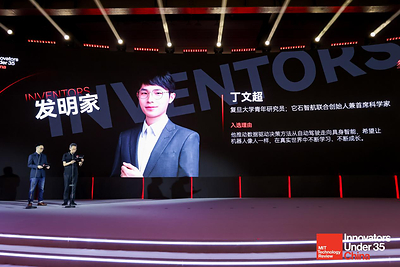

MIT Technology Review Names Dr. Wenchao Ding to the 2025 Innovators Under 35 China List
PR Newswire
SHANGHAI, Aug. 10, 2026
TARS Co-Founder and Chief Scientist Recognized for Contributions to Embodied AI Research and Innovation
SHANGHAI, Aug. 10, 2026 /PRNewswire/ — MIT Technology Review has named Dr. Wenchao Ding to the 2025 Innovators Under 35 China (TR35 China) list in the Inventor category. The annual program recognizes young innovators whose work is expected to shape the future of science and technology. Dr. Ding is Co-Founder and Chief Scientist of TARS, where he leads research and development in embodied AI.
The recognition comes as embodied AI gains momentum worldwide, driven by rapid advances in foundation models and growing demand for intelligent robots capable of operating in real-world environments. As foundation models expand beyond digital intelligence into physical systems, scalable learning, high-quality embodied data and robust real-world generalization have become central challenges for the field.
Dr. Ding’s research focuses on enabling robots to learn from human interaction with the physical world. His work introduced a human-centric approach to embodied AI that emphasizes large-scale learning from real-world human behavior before transferring that knowledge to robotic systems. The approach is designed to improve perception, reasoning, manipulation and generalization across diverse tasks and environments, providing a scalable pathway toward general-purpose robotics.
Under Dr. Ding’s technical leadership, TARS has developed an embodied AI technology stack spanning human-centric data paradigm and the AWE (AI World Engine) foundation model, supporting scalable learning and continuous model evolution.
The recognition coincides with the recent release of AWE 3.5, the latest generation of TARS’ embodied-native foundation model. AWE 3.5 marks a major step toward completing an end-to-end development framework spanning pre-training and post-training for embodied-native models, further validating TARS’ methodology for scalable embodied foundation model development. In addition, AWE 3.5 is trained on more than one million hours of human-centric real-world data and integrates perception, action, geometry and tactile capabilities within a unified architecture. The model is designed to strengthen long-horizon reasoning, dexterous manipulation and embodied decision-making, providing a scalable foundation for general-purpose embodied AI applications.
At the World Artificial Intelligence Conference (WAIC) 2026, TARS demonstrated AWE 3.5 performing multiple real-world manipulation tasks. The demonstrations illustrated how embodied foundation models are progressing from laboratory research toward practical deployment.
Dr. Ding’s selection reflects growing international recognition of embodied AI as foundation models move into real-world robotic systems. TARS continues advancing its Foundation Model + Application strategy, accelerating embodied AI deployment across manufacturing and industrial applications.
Follow TARS for updates:
X: @TARSRobotics
LinkedIn: https://www.linkedin.com/company/tarsrobotics
Contact:
tarspr@tars-ai.com
 View original content to download multimedia:https://www.prnewswire.com/news-releases/mit-technology-review-names-dr-wenchao-ding-to-the-2025-innovators-under-35-china-list-302847046.html
SOURCE TARS