Vadzo Imaging Positions Falcon-544CRH: 5MP AR0544 USB 3.2 Gen 1 Camera with VCM Autofocus, LI-HDR, and Wake on Motion for Smart City Solutions
Built for always-on urban monitoring where power budgets and image quality both matter, this compact USB camera pairs
Press Release Disclaimer: This is a press release distributed through the XPR Media network. It has not been independently verified by our newsroom.


Built for always-on urban monitoring where power budgets and image quality both matter, this compact USB camera pairs the onsemi HyperLux LP AR0544 sensor with LI-HDR, Wake on Motion triggering, and VCM autofocus, giving smart city integrators dependable color capture that stays in a low-power state until motion actually occurs.
FORT WORTH, TX / ACCESS Newswire / August 17, 2026 / Vadzo Imaging, a global leader in embedded vision solutions, today positions their Falcon-544CRH, a 5MP AR0544 USB Camera built around the Onsemi HyperLux LP sensor for smart city traffic monitoring, parking management, and municipal surveillance deployments that need both image quality and power efficiency.
Why Smart City Deployments Need a 5MP AR0544 USB Camera Built for Efficiency
Municipal camera networks face a scale problem that a single security installation never has to solve: hundreds or thousands of units running continuously, each one drawing power, generating heat, and adding to a bandwidth and storage bill that grows every year. A camera streaming full-resolution video around the clock, regardless of whether anything in the scene actually changed, spends most of that power and bandwidth capturing empty intersections, quiet parking rows, and unchanging street scenes.
An AR0544 Wake on Motion Camera approaches that problem differently. Rather than streaming continuously and asking downstream software to decide what matters, the sensor itself can drop into a low-power state and wake only when motion enters the frame, which meaningfully cuts the power and bandwidth cost of a large-scale deployment without asking a city to choose fewer camera units or lower resolution.
Engineering Explanation: Efficiency and Image Quality Together
Onsemi designed the HyperLux LP sensor family specifically for exactly this kind of large-scale, power-constrained deployment. As a HyperLux AR0544 Camera, the AR0544 combines a modern 5MP pixel array with the low-power circuit design that a HyperLux LP part is built around, rather than adapting a security-oriented sensor after the fact.
Dynamic range is the second engineering challenge smart city camera products face, since a single intersection camera has to handle direct sun, deep shadow, and vehicle headlights within the same frame. Rather than combining multiple exposures after capture, the sensor uses Linear HDR USB Camera processing, which onsemi calls LI-HDR, to extend dynamic range from a single linear exposure. This avoids the ghosting and motion artifacts that multi-frame HDR can introduce when a vehicle or pedestrian moves through the scene during capture, which matters directly for traffic and license plate applications where a smeared frame is a missed read.
Power efficiency and image quality come together in the Wake on Motion USB Camera design. Rather than running the full imaging pipeline continuously, the sensor maintains a Low Power Wake Camera state that monitors for motion at a fraction of normal power draw, then wakes to full resolution capture only when something in the scene actually changes.
Product Overview
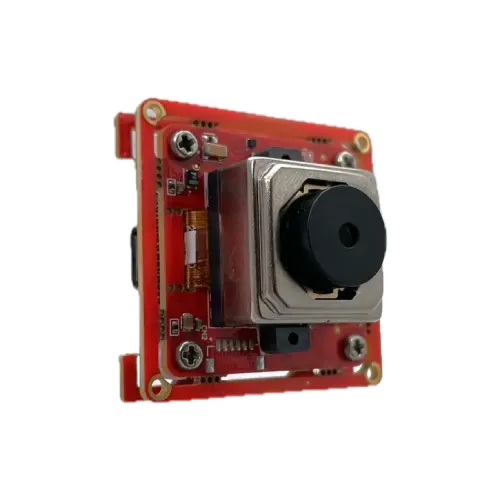
The Falcon-544CRH pairs the AR0544 HDR Camera sensor with a USB 3.2 Gen 1 interface and a VCM autofocus lens assembly in a compact board-level design suited to both direct integration and enclosed camera deployment. As a 5MP Wake on Motion USB Camera, it outputs 2592 × 1944 resolution while dropping into a low-power monitoring state between motion events. As a 5MP AR0544 USB Camera, it combines sensor performance with power efficiency for large-scale municipal deployment, and marketed as an AR0544 Smart City Camera, it targets exactly these large-scale, power-constrained deployments from the outset.
At the core of the module sits the Onsemi HyperLux LP Camera sensor, a 2.2 micron pixel design built specifically for the power and dynamic range demands of outdoor, continuously operating deployment. Because the sensor pairs 5MP LI-HDR USB Camera processing with wake-on-motion power management, the Falcon-544CRH reaches usable image quality across a full day and night cycle while drawing meaningfully less average power than a continuously streaming camera of similar resolution.
Key Capabilities
Onsemi HyperLux LP AR0544 Sensor for Efficient 5MP Capture: The Falcon-544CRH is built around the Onsemi HyperLux LP AR0544 sensor, a 2.2-micron pixel design that delivers full 5MP resolution without the power draw typically associated with sensors of this pixel count. This makes the module a genuine Low Power USB Camera Module rather than a standard sensor with power-saving features added after the fact.
LI-HDR for Wide Dynamic Range Without Motion Artifacts: Traffic and street-level scenes routinely combine direct sunlight, deep shadow, and vehicle headlights within the same frame, which is exactly the condition standard exposure handling struggles with. As an AR0544 LI-HDR Camera, the Falcon-544CRH extends dynamic range from a single linear exposure rather than combining multiple frames after capture, avoiding the ghosting that a moving vehicle or pedestrian would otherwise introduce into a blended HDR frame. This LI-HDR USB Camera behavior holds up under motion in ways multi-frame HDR cannot.
Wake on Motion for Efficient Around-the-Clock Operation: Running thousands of units continuously is rarely practical for a citywide deployment, which is why the Falcon-544CRH includes Wake on Motion power management as standard. As a Motion Triggered USB Camera, it monitors the scene at a fraction of normal power draw and wakes to full capture only when motion actually enters the frame, meaningfully reducing the average power and bandwidth cost of a large-scale rollout.
VCM Autofocus for Sharp Images Across Varying Distances: Unlike a fixed focus module, the Falcon-544CRH uses a VCM Focus Camera Module that adjusts focus electronically rather than requiring a technician to set focus manually at installation. This matters directly for pole-mounted, overhead, and variable distance smart city installations where the same camera model may need to focus anywhere from a few meters to well beyond typical fixed focus range.
USB 3.2 Gen 1 UVC Plug and Play Compatibility: As a UVC USB 3.2 Gen 1 Camera, the Falcon-544CRH enumerates automatically on Windows, Linux, macOS, and Android without a proprietary driver install, while the USB 3.2 Gen 1 interface supplies the bandwidth that full resolution HDR streaming actually requires. Functioning as a USB 3.2 Wake Camera, it also supports Wake on Motion signaling over the same connection, and this makes it a genuine Plug and Play Wake Camera for integrators adding vision capability to existing municipal infrastructure without a networked interface or a custom capture card.
Compact OEM Ready Design for Smart City Infrastructure: The board-level module’s VCM autofocus lens assembly gives OEM customers focus flexibility without the mechanical redesign a fixed lens change would require. Vadzo Imaging supports full customization on this platform as an OEM Wake Camera Module, including connector changes, cable length adjustment, and enclosure design for pole-mounted and outdoor-rated smart city infrastructure programs.
“Cities keep telling us the same thing: they want better camera coverage, but they cannot afford the power, bandwidth, and storage bill that comes with running thousands of units continuously at full resolution. The AR0544’s Wake on Motion design combined with LI-HDR gives the Falcon-544CRH real image quality when something is actually happening in the scene, without paying the power cost of a camera that streams the same empty intersection all night. We built this camera for deployments measured in the thousands of units, not the tens.” – Alwin Vincent, Product Manager at Vadzo Imaging.
Application-Specific Sections
Smart Traffic and Vehicle Monitoring: Intersections and roadways need vision that resolves both stopped and moving vehicles clearly enough for enforcement, counting, or incident detection. As a Smart Traffic Camera Module, the Falcon-544CRH’s LI-HDR handles headlight glare and shadow simultaneously, and a Vehicle Traffic Vision Camera configuration of the same module reads plates and vehicle details across a full day-and-night cycle.
Smart Parking Management: Parking structures and surface lots benefit from occupancy detection that does not require a camera streaming continuously across every space around the clock. A Smart Parking Camera built on this sensor wakes on vehicle motion to confirm occupancy changes, reducing the bandwidth and storage load of a lot-wide deployment compared to continuous streaming.
Municipal and Urban Surveillance: Public spaces, transit stops, and municipal facilities need coverage that scales across a city without a matching scale in power infrastructure. As a Municipal Surveillance Camera, the Falcon-544CRH’s low-power design reduces the electrical and cabling requirements of a citywide rollout, and an Urban Surveillance Camera configuration of the same module extends that same efficiency to pedestrian areas and public facilities.
Smart Street Lighting Integration: Combining vision with street lighting infrastructure lets a city add camera coverage without a separate pole or power run. A Smart Street Lighting Camera built around the AR0544 draws little enough power in Wake on Motion mode to share a lighting circuit’s existing power budget, extending vision coverage to corridors that would otherwise need dedicated camera infrastructure.
Smart City IoT and Edge Analytics: Edge compute deployments processing video locally rather than streaming everything to a central server need a camera that matches that lower bandwidth design philosophy. As a Smart City IoT Camera, the Falcon-544CRH pairs naturally with edge analytics hardware, and a Smart City Edge Camera configuration of the same module supports on-site processing for applications where sending continuous video off-site is neither necessary nor affordable.
Conclusion
Across traffic, parking, surveillance, and street lighting deployments, the common requirement is the same: vision that scales to thousands of units without a matching scale in power and bandwidth cost. The Falcon-544CRH answers that requirement as a 5MP HyperLux LP Camera built around LI-HDR imaging, Wake on Motion power management, and VCM autofocus, giving municipal integrators and OEM customers a single platform to standardize on across an entire smart city deployment.
Frequently Asked Questions
Q: How does a wake on motion camera save power compared to one that streams continuously?
A: A camera streaming continuously runs its full imaging pipeline at all times regardless of whether anything in the scene has actually changed, which spends power and bandwidth capturing empty intersections, quiet parking rows, and unchanging street scenes just as readily as it captures meaningful activity. A wake-on-motion design instead keeps the sensor in a low-power monitoring state and only activates full-resolution capture when motion is detected, which cuts average power draw significantly across a large deployment without reducing image quality when something actually happens. Vadzo Imaging builds this capability into its camera products specifically because municipal and IoT deployments are measured in hundreds or thousands of units, where even a modest reduction in power draw per camera unit adds up to a meaningful difference in total infrastructure cost.
Q: Why does autofocus matter for outdoor camera products that may be mounted at very different distances from their subject?
A: A fixed focus lens is set once at a single working distance and performs best only within a narrow range around that setting, which becomes a real limitation when the same camera model gets mounted on a short pole in one location and a tall pole or overhead structure in another. An autofocus lens assembly adjusts electronically to hold focus across that varying range without requiring a technician to manually set focus at every individual installation site. Vadzo Imaging includes autofocus on camera products intended for exactly this kind of varied mounting scenario, since it meaningfully reduces installation time and eliminates a common source of blurry footage that only becomes obvious after a unit is already deployed.
Q: What is the difference between linear HDR and standard multi-exposure HDR in an outdoor camera?
A: Standard multi-exposure HDR captures two or more frames at different exposure levels and blends them together afterward, which works well for still scenes but can introduce ghosting or smearing when something in the frame is moving during that capture sequence. Linear HDR instead extends dynamic range from a single exposure using the sensor’s own response curve, avoiding the frame blending step entirely and holding up under motion in a way multi-exposure blending cannot. Vadzo Imaging selects sensors with genuine linear HDR for outdoor and traffic-facing camera products specifically because vehicles, pedestrians, and other moving subjects are exactly the scenario where multi-exposure blending tends to fail.
Q: Can Vadzo Imaging customize a low power camera module for a specific IoT or municipal deployment?
A: Yes. Vadzo Imaging supports full OEM customization across its low power camera portfolio, including lens and focus configuration, connector and cable length changes, enclosure design rated for pole-mounted or outdoor use, and firmware tuning for a specific power or motion sensitivity profile. Evaluation units ship with no minimum order requirement, and the same engineering team that built the standard product works directly with municipal and OEM customers to adapt the module for large-scale deployment.
Q: How does Vadzo Imaging help cities and large deployments keep vision systems affordable to operate at scale?
A: The highest ongoing cost in a large vision deployment is rarely the camera hardware itself; it is the power, bandwidth, and storage required to keep hundreds or thousands of units running continuously. Vadzo Imaging designs its low-power camera products to reduce that operating cost directly, through power-efficient sensors, wake-on-motion capabilities that cut unnecessary streaming, and standard interfaces that avoid the added expense of proprietary networking hardware. That approach lets cities and large integrators budget for a deployment based on its true multi-year operating cost rather than hardware price alone.
Availability
The Falcon-544CRH 5MP AR0544 USB Camera is available now for evaluation and OEM integration. Evaluation kits include the camera module, a VCM autofocus lens preconfigured for common working distances, a USB 3.2 Gen 1 cable, and integration documentation covering UVC setup, Wake on Motion configuration, and Vispa ARC SDK setup, with no minimum order requirement. Contact Vadzo Imaging at support@vadzoimaging.com to request an evaluation unit or discuss volume production and OEM customization.
About Vadzo Imaging
Vadzo Imaging develops embedded and machine vision camera products for OEMs, system integrators, and municipal technology partners building production-ready vision systems across smart city infrastructure, security, robotics, and edge AI. The company’s portfolio spans MIPI CSI-2, USB, GigE, Wi-Fi, and SerDes interface camera products, supporting deployment architectures from compact onboard modules to distributed networked installations. Vadzo provides end-to-end imaging support including sensor integration, ISP tuning, firmware development, and SDK frameworks to accelerate system deployment. Visit Vadzo Imaging to explore the full embedded vision camera portfolio.
Media Contact
Alwin Vincent
Vadzo Imaging
Email: alwin@vadzoimaging.com
LinkedIn: Vadzo Imaging
YouTube: Vadzo Imaging
X: Vadzo Imaging
SOURCE: Vadzo Imaging
View the original press release on ACCESS Newswire
Media gallery