
Bottled Water Market to Reach USD 618.30 Billion by 2035 at 7.20% CAGR as Premium Hydration Drives Growth
Bottled water demand is rising as consumers prioritize convenient hydration, premium formats, functional products and
Press Release Disclaimer: This is a press release distributed through the XPR Media network. It has not been independently verified by our newsroom.

Bottled water demand is rising as consumers prioritize convenient hydration, premium formats, functional products and more sustainable packaging.
NEW YORK, NY, UNITED STATES, August 25, 2026 /EINPresswire.com/ —
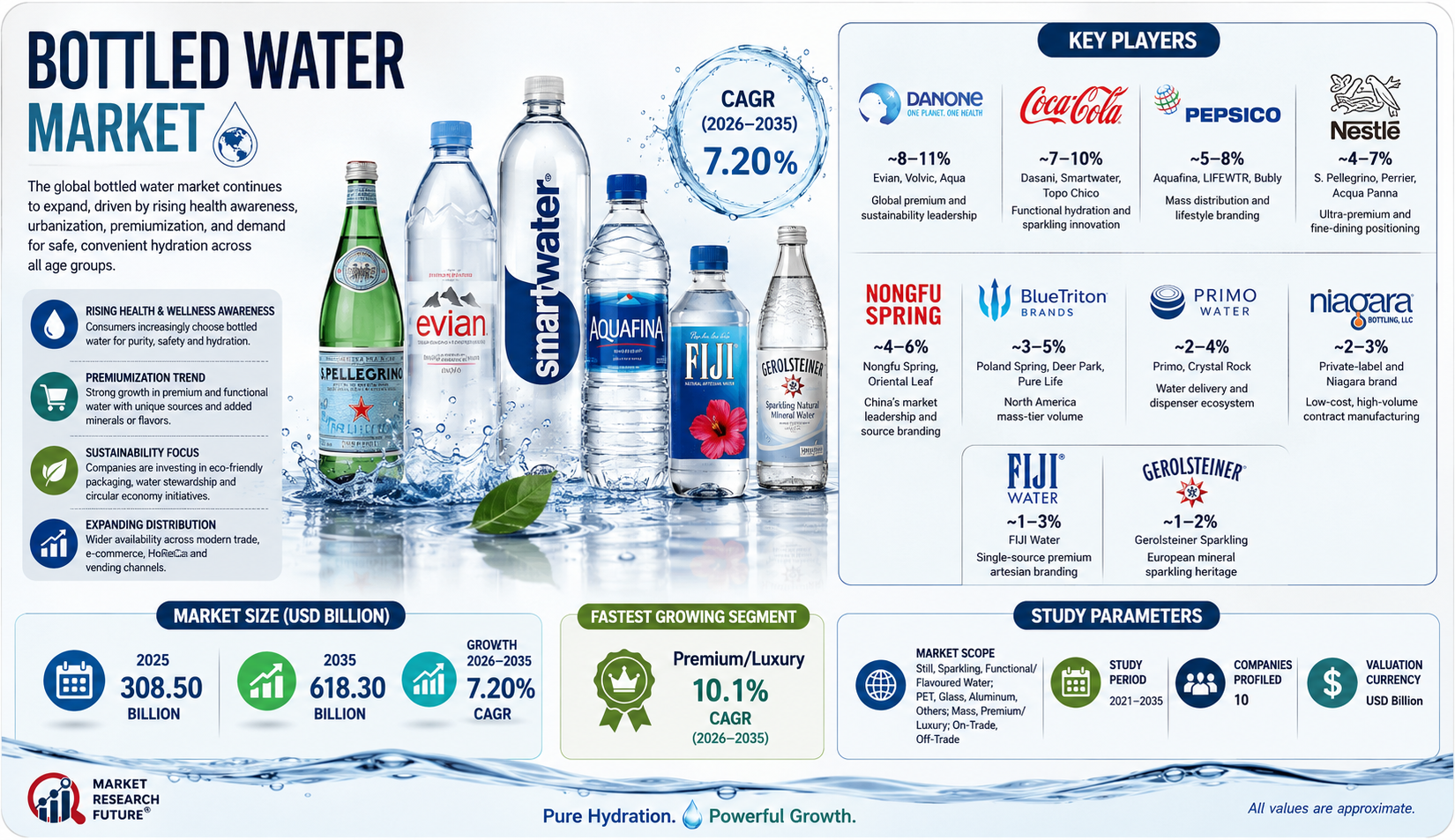
The global Bottled Water Market is entering a period of sustained expansion as urbanization, changing lifestyles, health-conscious consumption, tourism, foodservice activity, and demand for convenient hydration reshape beverage purchasing patterns. The market is projected to grow at a 7.20% CAGR from 2026 to 2035, reaching approximately USD 618.30 billion by 2035, compared with USD 308.50 billion in 2025. Growth is increasingly being supported not only by conventional still water but also by sparkling, flavored, functional, premium, and luxury offerings. At the same time, manufacturers are adapting their portfolios to address packaging waste, resource management, product differentiation, and evolving consumer expectations.
The competitive landscape remains fragmented across regional and international brands, with companies competing through source differentiation, distribution scale, packaging innovation, product diversification, and brand positioning. Danone S.A. maintains a strong premium and sustainability-oriented position through Evian, Volvic, and Aqua, while The Coca-Cola Company competes across mainstream and functional hydration through Dasani, Smartwater, and Topo Chico. PepsiCo, Inc. leverages extensive distribution through Aquafina and lifestyle-oriented brands, while Nestlé S.A. emphasizes premium and fine-dining positioning through S. Pellegrino, Perrier, and Acqua Panna. Other important participants include Nongfu Spring Co., Ltd., BlueTriton Brands, Primo Water Corporation, Niagara Bottling, LLC, The Wonderful Company (FIJI), and Gerolsteiner Brunnen GmbH.
Free Sample Copy Access A Complimentary Copy of Our Report to Explore Its Content and Insights
https://www.marketresearchfuture.com/sample_request/2252
Market Drivers and Emerging Demand Patterns
One of the principal growth drivers is the increasing preference for convenient hydration. Consumers frequently purchase bottled water while traveling, commuting, exercising, working, dining out, or attending public events. In developing urban markets, expanding modern retail infrastructure and improved cold-chain availability are also increasing product accessibility.
Health and wellness trends provide another structural growth opportunity. Consumers are increasingly replacing carbonated soft drinks and high-sugar beverages with water-based alternatives. This shift is expanding demand for mineral water, electrolyte-enhanced water, vitamin-infused products, alkaline water, and flavored water. However, the functional segment remains dependent on credible product differentiation, regulatory compliance, and consumer willingness to pay a premium.
Premiumization is particularly significant. The Premium/Luxury segment is expected to record the fastest growth, at approximately 10.1% CAGR, reflecting demand for distinctive mineral compositions, recognizable natural sources, premium packaging, restaurant positioning, and brand heritage. Premium water is increasingly marketed as a sensory and lifestyle product rather than simply a basic hydration commodity.
Product-Type Segmentation
Still water remains the foundational category because of its broad consumer acceptance, affordability, and extensive availability across supermarkets, convenience stores, vending channels, restaurants, hotels, and institutional settings. Large-volume PET formats continue to serve mainstream consumption, while premium brands increasingly use glass and distinctive bottle designs to differentiate products.
Sparkling water represents a higher-value opportunity, particularly in mature beverage markets. Its association with dining occasions and reduced-sugar consumption has helped expand its role as an alternative to soft drinks. Brands are also introducing flavored sparkling varieties to attract consumers seeking greater sensory variety.
Functional and flavored water is gaining relevance as beverage companies seek products with additional perceived benefits. Electrolytes, vitamins, minerals, botanical ingredients, and natural flavors allow companies to target fitness, wellness, and lifestyle occasions. This segment also provides opportunities for higher margins and stronger product differentiation.
Packaging Segmentation
PET bottles remain essential because they are lightweight, relatively economical, durable, and suitable for high-volume distribution. However, sustainability concerns surrounding single-use plastics are encouraging greater use of recycled PET, lightweighting, collection systems, and alternative packaging.
Glass bottles are strongly associated with premium and luxury positioning. They are particularly relevant in restaurants, hotels, cafés, and fine-dining environments where presentation and brand identity influence purchasing decisions. Their higher transportation weight and production requirements, however, can affect cost and logistics.
Aluminum cans and bottles provide another packaging pathway, particularly for sparkling and flavored water. Their portability, recyclability, and compatibility with modern beverage formats make them attractive for selected consumption occasions. Other packaging formats, including larger reusable containers and emerging low-plastic solutions, are also gaining attention.
Price-Tier Segmentation
The mass segment accounts for high-volume consumption and is driven primarily by affordability, availability, brand recognition, and distribution reach. Competition in this tier is intense because consumers can readily substitute between brands.
The premium/luxury segment, meanwhile, focuses on provenance, mineral composition, packaging aesthetics, source storytelling, exclusivity, and foodservice visibility. Premium brands can command substantially higher prices by creating differentiated consumer experiences. This segment is expected to outperform the broader market, registering the forecast 10.1% CAGR.
Distribution Channel Segmentation
Off-trade channels such as supermarkets, hypermarkets, convenience stores, grocery retailers, e-commerce platforms, vending machines, and direct delivery remain central to bottled water distribution. E-commerce is particularly relevant for multipacks, subscription purchases, premium products, and household delivery.
On-trade channels include restaurants, cafés, hotels, bars, catering businesses, and entertainment venues. Premium and sparkling waters have strong relevance in these environments because product presentation and food pairing can influence purchasing decisions. Tourism and hospitality recovery also support demand through hotels, airports, restaurants, and event venues.
Industry Developments
1. Danone strengthens its long-term water strategy: In April 2026, Danone marked the 200th anniversary of Evian and announced a new phase centered on resource preservation, industrial excellence, and innovation. The development highlights how major water companies are increasingly linking brand growth with watershed protection and operational improvements.
2. PepsiCo expands water-risk reporting and replenishment efforts: In June 2026, PepsiCo reported progress toward its 2030 water ambitions and expanded the scope of its reporting to include company-owned and franchise-bottler manufacturing facilities located in high-water-risk areas. The company reported 58% progress toward its 2030 watershed replenishment goal, equivalent to 23 billion liters returned, restored, or replenished.
These developments illustrate a broader industry transition in which water stewardship, packaging efficiency, resource security, and supply-chain resilience are becoming strategic considerations alongside volume growth.
Proceed To Buy Move Forward with Your Purchase and Gain Instant Access to the Complete Report
https://www.marketresearchfuture.com/checkout?currency=one_user-USD&report_id=2252
Competitive Landscape and Key Players
Competition is shaped by a combination of global scale and strong regional franchises. Danone emphasizes premium natural mineral water and sustainability, while Coca-Cola combines mass-market distribution with functional and sparkling hydration. PepsiCo benefits from extensive retail penetration and lifestyle branding. Nestlé maintains an ultra-premium position through internationally recognized mineral and sparkling brands.
Regional strength is equally important. Nongfu Spring benefits from China’s large domestic market and source-oriented branding. BlueTriton Brands maintains a substantial North American mass-market presence, while Primo Water Corporation differentiates itself through water delivery and dispenser ecosystems. Niagara Bottling focuses on high-volume manufacturing and private-label supply. FIJI Water emphasizes single-source premium artesian positioning, while Gerolsteiner draws on European mineral-water heritage and sparkling specialization.
Market Outlook
The outlook through 2035 suggests that bottled water will increasingly develop into a diversified beverage ecosystem rather than remain a standardized commodity category. Traditional still water is expected to retain its volume leadership, but premium, functional, flavored, and sparkling products should contribute disproportionately to value growth.
Packaging will remain a decisive competitive issue. Companies that can balance cost, product protection, recyclability, material efficiency, and consumer convenience are likely to strengthen their market positions. Water-resource management will also become increasingly important as producers face greater scrutiny over sourcing and environmental impact.
For consumers, the category is likely to offer greater variety across formats, price points, functional attributes, and packaging materials. For manufacturers, growth opportunities will increasingly depend on combining reliable water sourcing with efficient distribution, differentiated branding, innovation, and measurable sustainability practices.
Overall, the global Bottled Water Market is positioned for substantial expansion, rising from USD 308.50 billion in 2025 to USD 618.30 billion by 2035, representing a 7.20% CAGR during 2026–2035. Premiumization, convenience, wellness-oriented consumption, sparkling and functional innovation, and expanding distribution networks will remain important growth engines. At the same time, packaging and water-resource considerations will increasingly influence competitive strategy.
Frequently Asked Questions
1. What is the projected size of the Bottled Water Market by 2035?
The global Bottled Water Market is projected to reach USD 618.30 billion by 2035, growing at a 7.20% CAGR from 2026 to 2035.
2. Which Bottled Water Market segment is expected to grow fastest?
The Premium/Luxury segment is expected to be the fastest-growing segment, with a projected 10.1% CAGR, supported by premium positioning, distinctive sources, packaging, and changing consumer preferences.
Read Our Related Research Report
Hydrogen Water Market –
https://www.marketresearchfuture.com/reports/hydrogen-water-market-29741
Water Ionizers Market –
https://www.marketresearchfuture.com/reports/water-ionizers-market-25744
Water Bottle Market –
https://www.marketresearchfuture.com/reports/water-bottle-market-12479
Sagar Kadam
Market Research Future
+1 628-258-0071
email us here
Legal Disclaimer:
EIN Presswire provides this news content “as is” without warranty of any kind. We do not accept any responsibility or liability
for the accuracy, content, images, videos, licenses, completeness, legality, or reliability of the information contained in this
article. If you have any complaints or copyright issues related to this article, kindly contact the author above.

Media gallery


