Evolve Collision Centers Explains Repair vs. Replacement Decisions After a Collision
Ardmore, PA - August 31, 2026 - PRESSADVANTAGE - Evolve Collision Centers has published new consumer information
Press Release Disclaimer: This is a press release distributed through the XPR Media network. It has not been independently verified by our newsroom.

Ardmore, PA – August 31, 2026 – PRESSADVANTAGE –
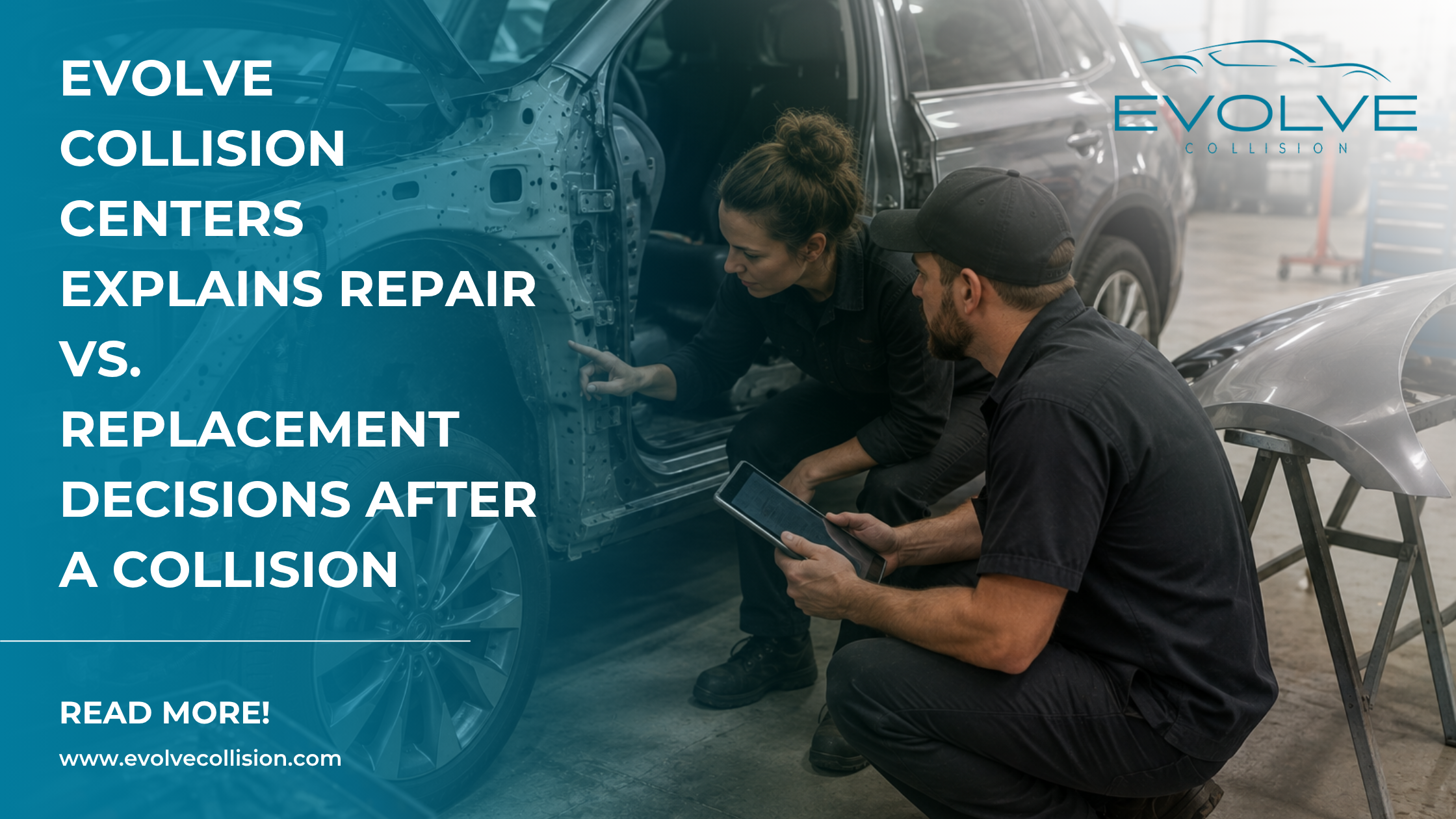
Evolve Collision Centers has published new consumer information explaining how repair professionals evaluate whether a collision-damaged vehicle component may be repaired or requires replacement. The August resource focuses on the factors that can influence these decisions, including component condition, construction material, damage location, accessibility, attachment points, and vehicle-specific manufacturer procedures.
The publication was developed to give vehicle owners clearer context for a decision that can significantly shape a collision repair plan. A damaged bumper, fender, door, hood, quarter panel, or other exterior component does not automatically fall into a repair or replacement category based solely on how the damage appears.
Instead, the appropriate approach depends on the individual vehicle and the condition documented during the evaluation and repair-planning process.
For drivers, this distinction can be important because two damaged components that look similar from the outside may require different procedures. A shallow deformation on one panel may present different considerations from damage located near an edge, body line, attachment point, reinforcement, or another area that affects how the component can be addressed.
Evolve Collision Centers’ August information begins with the role of damage evaluation.
Technicians can document the location, size, depth, and characteristics of visible collision damage along with the condition of the surrounding area. The evaluation can also consider whether mounting locations, adjacent components, or other areas were affected by the impact.
This initial information helps establish the condition of the component, but exterior appearance alone may not provide every detail required for the repair plan.
When applicable removal or disassembly provides additional access, previously covered areas can be evaluated. Brackets, fasteners, reinforcements, attachment points, wiring, and neighboring components may become relevant depending on the location and nature of the collision.
Any additional conditions identified during this process can then be documented before repair-versus-replacement decisions are finalized.
Evolve Collision Centers provides additional information about these stages through its collision repair resource.
Component material is another important consideration.
Modern vehicles can incorporate different grades of steel, aluminum, plastics, composites, and other materials. These materials have different characteristics, and the procedures applicable to repairing them can vary by component and vehicle.
A damaged steel panel, for example, should not automatically be evaluated according to the same criteria as an aluminum panel or plastic bumper cover. Even components made from broadly similar materials can have different requirements because of their construction, location, or function.
This is one reason Evolve Collision Centers’ August guidance avoids presenting a universal threshold for deciding when a component should be repaired or replaced.
Instead, vehicle-specific technical information can become part of the decision.
Vehicle manufacturers publish repair procedures and specifications addressing particular components and operations. Depending on the vehicle, this information can include whether a component is considered repairable, when replacement is specified, approved joining methods, attachment locations, sectioning procedures, measurements, corrosion protection, and other requirements.
Reviewing applicable manufacturer information helps connect the repair plan to the particular vehicle rather than relying exclusively on a generalized assessment of how severe the damage appears.
The location of the damage can also matter.
Damage concentrated in the middle of an exterior panel can present different repair considerations from damage affecting an edge, mounting location, body line, seam, reinforcement, or another functionally important area.
Similarly, a component with relatively limited visible damage may require a different approach if the affected area involves attachment points or other features relevant to the component’s installation.
The August publication emphasizes that these examples should not be interpreted as automatic replacement criteria. They illustrate why repair-versus-replacement decisions require evaluation of the actual component and applicable repair information.
The same principle applies to bumper damage.
A bumper assembly can include more than the painted exterior cover visible to the driver. Depending on the vehicle, the assembly may incorporate reinforcement components, energy-absorbing materials, brackets, fasteners, wiring, sensors, and other equipment.
Damage to the bumper cover therefore does not necessarily describe the condition of the complete assembly. Appropriate evaluation can identify which components were affected and which repair or replacement procedures apply.
For exterior panels with dents and relatively limited paint damage, paintless dent repair may sometimes represent another repair consideration. Whether the process is appropriate depends on factors such as the location and characteristics of the dent, accessibility, panel material, paint condition, and other vehicle-specific considerations.
Evolve Collision Centers provides more information about this method through its paintless dent repair resource.
The August guidance also addresses modern vehicle technology as part of repair-versus-replacement planning.
Cameras, radar units, parking sensors, wiring, and other advanced driver-assistance system components may be installed in or near bumpers, mirrors, windshields, lamps, and other exterior areas. Their presence can introduce additional vehicle-specific procedures when an associated component is repaired, removed, replaced, or reinstalled.
This does not mean that replacing or repairing a nearby component automatically requires calibration or another specific operation. Applicable procedures depend on the vehicle, affected system, work performed, and manufacturer requirements.
The interaction between physical components and electronic systems illustrates why contemporary collision repair decisions can extend beyond choosing the method that produces the desired exterior appearance.
Refinishing requirements can also influence the overall repair process.
When a damaged component is repaired, the affected surface may require preparation and refinishing depending on its condition and the repair operation performed. Replacement components can likewise require preparation and refinishing according to the part, materials, and applicable procedures.
As a result, repair and replacement should not be viewed simply as shortcuts or opposing measures of repair quality. Each represents a possible operation within a broader vehicle-specific repair plan.
Evolve Collision Centers’ August publication also gives consumers context for why an initial estimate can change as repair planning progresses.
An early assessment is based on information reasonably available at that stage. If additional collision-related conditions become documented after appropriate access is obtained, or if manufacturer research identifies procedures relevant to the affected component, the repair plan can be updated accordingly.
A component initially considered for repair may therefore require further evaluation, just as a visibly damaged component should not automatically be assumed to require replacement.
The guide encourages consumers to view repair-versus-replacement decisions through the condition of the component and the technical information applicable to the vehicle rather than through a simple assumption that one option is always preferable.
Cost and speed alone also do not establish the appropriate repair method. The operation selected for an individual component should reflect its documented condition, construction, affected area, and applicable procedures.
For vehicle owners, understanding these factors can make repair estimates and repair-plan discussions easier to follow. Terms such as repairability, replacement, disassembly, manufacturer procedure, and supplemental repair information describe different parts of a process that develops around the individual vehicle.
The August publication is intended as consumer education rather than a diagnostic standard. A repair-versus-replacement determination for a particular vehicle requires evaluation of the affected component and review of the technical information applicable to that repair.
Additional information about panel and component repairs is available through Evolve Collision Centers’ auto body repair resource.
For drivers in Ardmore and surrounding Main Line communities, Evolve Collision Centers provides collision and auto body repair services from its facility at 2560 Haverford Rd, Ardmore, PA 19003.
About Evolve Collision Centers
Evolve Collision Centers provides collision and related automotive repair services, including auto body repair, paintless dent repair, refinishing, auto glass work, vehicle scanning and calibration, and OEM-certified repair capabilities. The company serves vehicle owners in Ardmore and surrounding Main Line communities.
###
For more information about Evolve Collision Centers, contact the company here:
Evolve Collision Centers
Butch Cantz
(267) 692-6699
bcantz@evolvecollision.com
2560 Haverford Rd, Ardmore, PA 19003