Fermi Explorer Set To Launch Humanity’s First Journey To Another Star
New nonprofit to launch the first interstellar mission to the nearest star system, Alpha Centauri, by the end of 2029
Press Release Disclaimer: This is a press release distributed through the XPR Media network. It has not been independently verified by our newsroom.


The Fermi Explorer Mission, a new nonprofit, unveiled today its roadmap to launch humanity’s first spacecraft to another star system by 2029.
This press release features multimedia. View the full release here: https://www.businesswire.com/news/home/20260901669444/en/
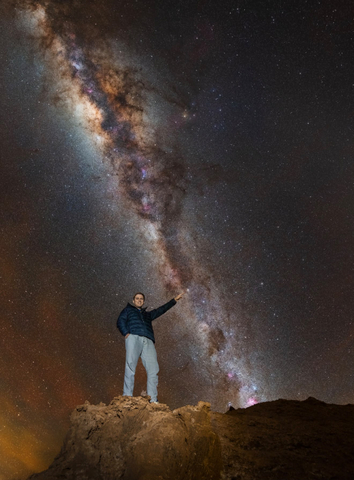
Fermi Explorer Co-Founder & President, Philip Johnston, pointing at the exact star, Alpha Centauri, the target of the mission, with the Milky Way in view. Taken July, 2026 by astrophotographer, Alexis Trigo, in the Atacama Desert, Chile, with 20-second exposure.
Instead of needing billions of dollars, or propulsion breakthroughs that may take generations to develop, the nonprofit is designing around flight-proven electric propulsion and the constraints of what can be built today. Fermi Explorer aims to launch by the end of 2029, and the journey toward Alpha Centauri is expected to span roughly 80,000 years (as shown in the concept video).
That timeline is not an argument against the mission. It is the reason to begin.
“We hope to be both the first to leave and the last to arrive at Alpha Centauri. None of us will be here when this journey ends, and that is the point. It’s about taking the first achievable step and inspiring future generations to keep pushing beyond the limits we inherited.”
-Philip Johnston, Co-Founder & President of The Fermi Explorer Mission
Satellite manufacturers will be invited to bid on the mission with the following 4 goals:
- Aim: To launch the first spacecraft to another star. It should get at least 99% of the way to the nearest star system, Alpha Centauri, within 80,000 years.
- Payload: It should have at least a 1kg, 10x10x10 cm payload.
- Schedule: It should launch before the end of 2029
- Cost: It should cost less than $15M to design, build, launch, and operate.
The Fermi Explorer team has designed a feasible mission profile as detailed here, though they are open to new ideas from the satellite manufacturers. The team also worked with a new physical AI lab called PSI – Physical Super Intelligence, which conducted a feasibility study and devised the final ‘perihelion pump’ maneuver, as detailed in their report here.
There will soon be a three-month solicitation period for proposals for scientific and artistic payloads to be added to the mission. The mission also plans to include a copy of the Golden Record, as well as messages from children around the world for future civilizations.
Fermi Explorer plans to open-source its research, analysis, data, and simulation tools so scientists, engineers, educators, students, and curious contributors can test assumptions, improve the mission, and propose useful science for the journey. A child who discovers the project today should be able to learn from it, contribute to it, and watch it launch before graduating from high school.
The mission has picked up some early supporters, including Rob Meyerson, former President of Blue Origin, and Alex Wissner-Gross, MIT physicist and investor. The organization is inviting people to participate by either donating to the mission and/or contributing research and technical expertise, scientific and artistic proposals.
“The most inspiring part of this mission is that people do not have to wait for permission or perfect conditions,” said Garrett Jameson, former US Air Force officer who leads day-to-day execution. “We can embrace the constraints, build what is possible now, and give the next generation something meaningful to build upon.”
Learn more, contribute, or follow the mission at fermiexplorer.org.
About Fermi Explorer
Fermi Explorer Mission is a 501c3 nonprofit organization that will launch humanity’s first spacecraft to another star.
View source version on businesswire.com: https://www.businesswire.com/news/home/20260901669444/en/
Media gallery