Instantaneous UAV tracking using single-photon LiDAR via photon-event-driven suppression of temporal-averaging bias
SHANNON, CLARE, IRELAND, September 1, 2026 /EINPresswire.com/ -- Announcing a new publication from Opto-Electronic
Press Release Disclaimer: This is a press release distributed through the XPR Media network. It has not been independently verified by our newsroom.
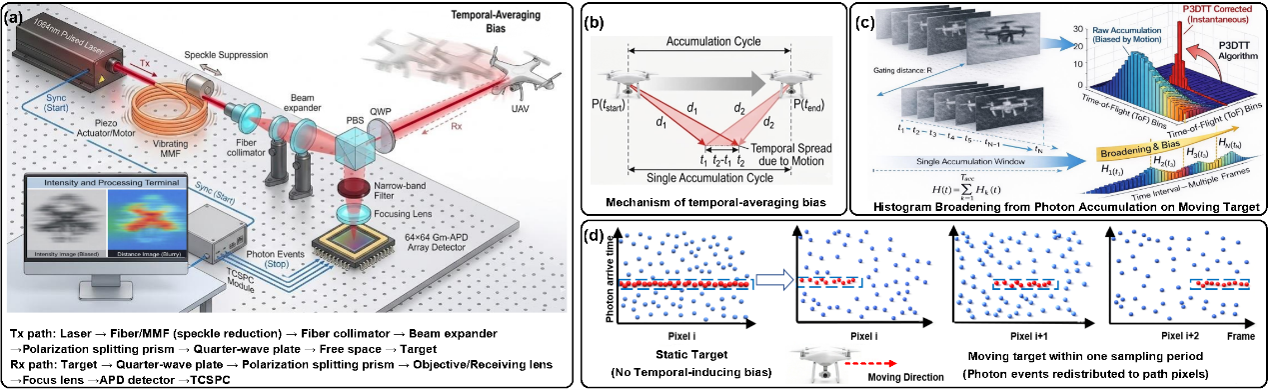

SHANNON, CLARE, IRELAND, September 1, 2026 /EINPresswire.com/ — Announcing a new publication from Opto-Electronic Technology; DOI 10.29026/oet.2026.260013.
Single-photon LiDAR is an advanced active optical imaging technology that combines single-photon-level sensitivity with nanosecond-scale temporal resolution. It has demonstrated substantial potential in precision imaging and long-range static sensing. Based on time-correlated single-photon counting, the technique accumulates photon events over multiple laser-emission cycles to extract sparse target returns from strong background noise. For stationary targets, this accumulation improves statistical significance. For moving targets, however, spatial displacement during the sampling interval causes photons returned from different spatiotemporal positions to be compressed into the same integration window. The result is spatial spreading of photon energy and temporal broadening of the trigger distribution, meaning that conventional methods can recover only a weighted-average position along the target trajectory rather than its instantaneous location.
Reconciling photon-statistical gain with instantaneous dynamic measurement has therefore become a central challenge in advancing single-photon LiDAR from static imaging to dynamic sensing. To address this problem, the research team analyzed the photon-triggering model and the mechanism of motion-induced photon dispersion. They defined the “motion-induced temporal-averaging effect” in single-photon dynamic detection and revealed the fundamental conflict between the accumulation required to enhance weak echoes and the instantaneous measurement demanded by high-speed motion.
To overcome the motion-induced temporal-averaging bias caused by multi-pulse accumulation in dynamic single-photon LiDAR, the team developed a photon-event-driven three-dimensional dynamic target-tracking method, termed P3DTT. The method addresses the photon-limited bottleneck in which a moving target can be detected but its instantaneous position remains difficult to determine. By exploiting the dynamic consistency of photons scattered from the target across spatial location, arrival time, and inter-frame displacement, P3DTT identifies target-generated photon events against strong background noise. It then rearranges and refocuses these events in space and time, reconstructing the instantaneous target position throughout the sampling window and enabling continuous 3D tracking. In this way, the method effectively suppresses the impact of temporal averaging on dynamic imaging and localization accuracy.Monte Carlo simulations showed that, with only 0.2184 signal photons per pixel on average and a signal-to-noise ratio as low as −8.37 dB, P3DTT could recover the instantaneous position of a dynamic target moving at a three-dimensional velocity of up to 188.8 m/s and perform continuous 3D tracking. The method reduced the instantaneous time-of-flight localization error from 4.71 ns to 0.33 ns, corresponding to an approximately 14-fold improvement over publicly reported international results. The algorithm was further implemented on the team’s independently developed, fully domestic area-array Gm-APD single-photon LiDAR system. Under intense stray illumination of 12,500 lux and with only 0.2731 signal photons per pixel on average, the system achieved instantaneous position estimation and continuous 3D tracking of a moving UAV at a range of 2.5 km, with a 3D tracking error below 0.4375 m.
The results demonstrate that photon dispersion generated by a moving target within the sampling window is not merely an imaging artifact. Instead, it is an evolving photon-event process that encodes the target’s motion state. By exploiting the spatiotemporal correlations created by motion-parameter consistency, P3DTT can identify and use photon events that conventional accumulation methods merge together, thereby recovering the target’s instantaneous 3D position. This work breaks the conventional trade-off between photon-statistical gain and instantaneous measurement accuracy and provides a new technical route for advancing single-photon LiDAR from static integration imaging toward practical long-range dynamic sensing.
This work was supported by the National Natural Science Foundation of China (Grant No. 62505069), the National Key Laboratory of Laser Spatial Information (Grant No. LSI2024WDZC04), and the China Scholarship Council (Grant No. 202606120073).
Keywords: single-photon LiDAR, instantaneous 3D tracking, photon event, computational imaging, Gm-APD
# # # # # #
The research team is affiliated with the National Key Laboratory of Laser Spatial Information, School of Astronautics, Harbin Institute of Technology. The team has long pursued research in single-photon LiDAR, laser imaging radar, LiDAR signal and image processing, and high-sensitivity photoelectric detection. Its work addresses complex ground-, maritime-, and air-oriented sensing scenarios and has established a comprehensive research foundation spanning physical-mechanism modeling, algorithm development, system engineering, and field validation.
The team is led by Prof. Jianfeng Sun, who also serves as Secretary-General of the Heilongjiang Optical Society and Vice Chair of the IEEE Electron Devices Society Harbin Chapter. In recent years, he has served as principal investigator on more than ten national pre-research projects. The team has published more than 70 SCI/EI-indexed papers in optics journals including Optica and Photonics Research and has been granted more than 30 Chinese invention patents related to single-photon detection technologies. With strong capabilities in scientific research, system integration, and technology transfer, the team provides important support for moving single-photon LiDAR from fundamental research toward practical deployment.
Team leader: Prof. Jianfeng Sun
Email: sjf@hit.edu.cn
Faculty webpage: http://homepage.hit.edu.cn/sunjianfeng
# # # # # #
Opto-Electronic Technology (OET) is an international, peer-reviewed and open access English language journal. OET publishes reviews, research articles and letters covering engineering technologies and applications of optics, photonics and optoelectronics.
# # # # # #
More information: https://www.oejournal.org/oet/en/
Editorial Board: https://www.oejournal.org/oet/en/editorial_board/oetEditorialBoard
All issues available in the online archive (https://www.oejournal.org/oet/archive_list_en)
Submission of OET may be made using ScholarOne (https://mc03.manuscriptcentral.com/oet)
ISSN (Print) 2097-6003
CN 51-1811/O4
Contact Us: oet@ioe.ac.cn
Twitter: @OptoElectronAdv (https://twitter.com/OptoElectronAdv?lang=en)
WeChat: OE_Journal
# # # # # #
Guo DF, Sun JF, Zhou X et al. Instantaneous UAV tracking using single-photon LiDAR via photon-event-driven suppression of temporal-averaging bias. Opto-Electron Technol 2, 260013 (2026). DOI: 10.29026/oet.2026.260013
Opto-Electronic Technology Editorial Office
Opto-Electronic Technology
123456789
email us here
Legal Disclaimer:
EIN Presswire provides this news content “as is” without warranty of any kind. We do not accept any responsibility or liability
for the accuracy, content, images, videos, licenses, completeness, legality, or reliability of the information contained in this
article. If you have any complaints or copyright issues related to this article, kindly contact the author above.

Media gallery