Future of Synthetic Diamonds: Market Growth and Emerging Applications 2026–2035
NEW YORK, NY, UNITED STATES, September 9, 2026 /EINPresswire.com/ -- The synthetic diamond industry is undergoing a
Press Release Disclaimer: This is a press release distributed through the XPR Media network. It has not been independently verified by our newsroom.

NEW YORK, NY, UNITED STATES, September 9, 2026 /EINPresswire.com/ —
The synthetic diamond industry is undergoing a significant transformation as technological advances, growing industrial applications, and changing consumer preferences expand the use of laboratory-grown diamonds beyond traditional jewelry. Synthetic diamonds are increasingly being used in construction, mining, electronics, semiconductors, healthcare, optics, and advanced manufacturing.
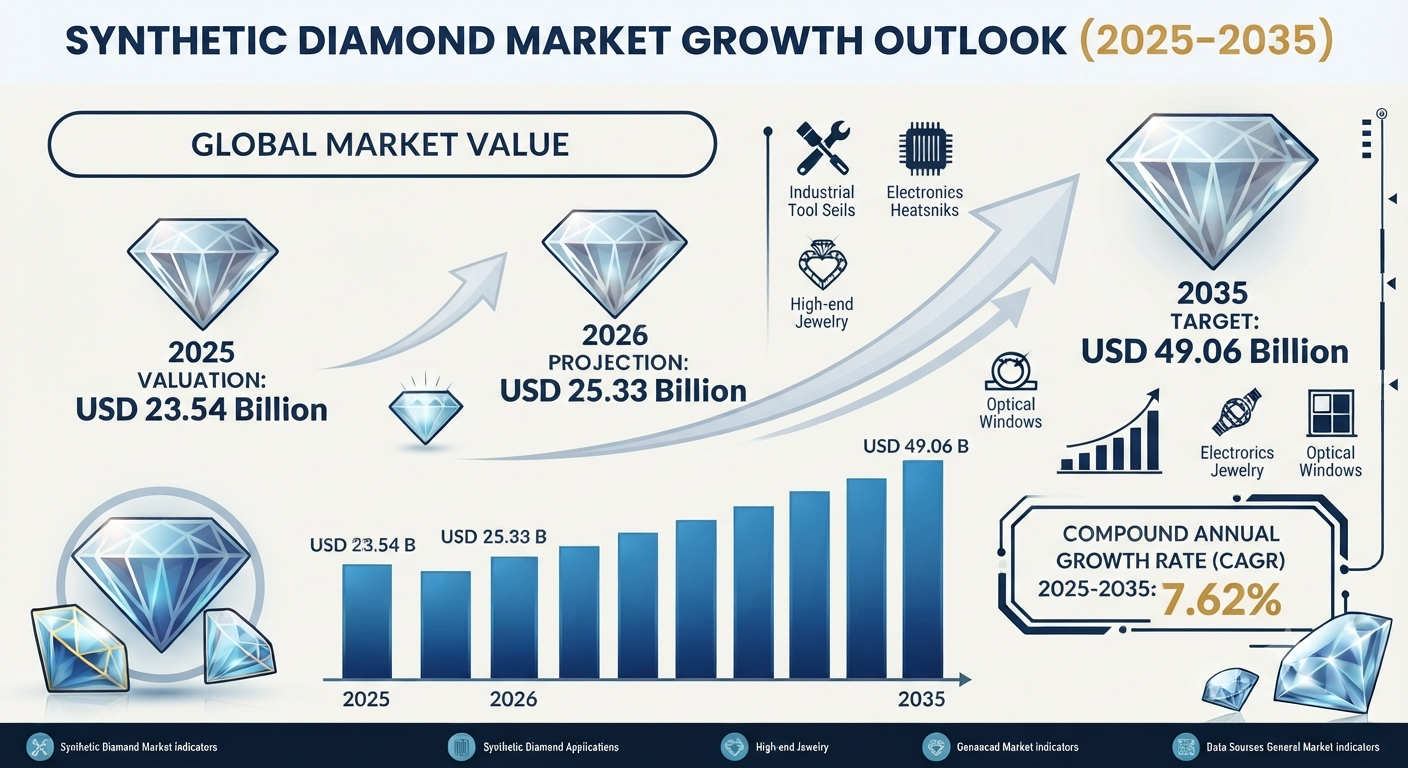
According to the latest Market Research Future analysis, the global synthetic diamond market was valued at approximately USD 23.54 billion in 2025. The market is projected to increase from USD 25.33 billion in 2026 to USD 49.06 billion by 2035, representing a 7.62% CAGR during 2026–2035.
What Are Synthetic Diamonds?
Synthetic diamonds, also known as laboratory-grown or lab-created diamonds, are manufactured using advanced technologies that reproduce the conditions under which natural diamonds form. Although their production is controlled in a laboratory or industrial environment, they possess the fundamental physical and chemical characteristics of natural diamonds.
The two primary technologies used to manufacture synthetic diamonds are High Pressure High Temperature (HPHT) and Chemical Vapor Deposition (CVD).
HPHT technology uses extremely high pressure and temperature to transform carbon into diamond. It remains particularly important for industrial applications and abrasive materials.
CVD technology creates diamond layers from carbon-containing gases in a controlled chamber. Its ability to produce high-purity material and specialized geometries makes it increasingly important for electronics, optics, semiconductor applications, quantum technologies, and premium gem production.
Synthetic Diamond Market Growth
Several factors are contributing to the expansion of the synthetic diamond market.
One of the most important drivers is the increasing demand for diamond-based industrial tools. Synthetic diamonds are extremely hard and wear-resistant, making them valuable for cutting, drilling, grinding, polishing, and machining applications.
The construction and mining sector represented the largest application category in 2025, generating approximately USD 7.89 billion in market value. Demand from infrastructure development, mining operations, drilling, and aggregate processing continues to support the industrial segment.
At the same time, electronics and semiconductor applications are emerging as some of the fastest-growing opportunities. The report estimates that electronics and semiconductor demand could expand at approximately 11.8% CAGR between 2026 and 2035.
Get Sample @ https://www.marketresearchfuture.com/sample_request/11833
Key Market Trends
1. Rising Demand for CVD Diamonds
Chemical Vapor Deposition is becoming one of the most important technologies in the synthetic diamond industry. The CVD segment is forecast to grow at approximately 11.29% CAGR through 2035, significantly faster than the overall market.
CVD technology is particularly attractive where manufacturers require high purity, controlled material properties, large surfaces, and specialized diamond substrates.
2. Growing Use in Electronics and Semiconductors
Diamond has exceptional thermal conductivity, making it attractive for thermal management in high-performance electronic systems.
As power electronics, radio-frequency devices, artificial intelligence infrastructure, and telecommunications equipment become increasingly powerful, managing heat has become a major engineering challenge. Diamond substrates and heat spreaders can help improve thermal performance in selected applications.
The development of diamond-based substrates for power and RF semiconductor systems therefore represents a potentially high-value opportunity for manufacturers.
3. Expansion of Lab-Grown Diamond Jewelry
Synthetic diamonds have also gained popularity in the jewelry industry. Their lower cost compared with many natural diamonds, combined with improvements in quality and manufacturing technology, has increased consumer interest.
Lab-grown diamonds can be produced in a variety of sizes, shapes, and colors, allowing jewelry manufacturers to offer more design flexibility.
However, the jewelry segment faces an important challenge: continued increases in supply have contributed to declining prices for laboratory-grown gemstones. As a result, future growth in this segment is expected to depend increasingly on volume, branding, design, traceability, and differentiation.
4. Diamond-Based Tools for Electric Vehicle Manufacturing
The transition toward electric vehicles is creating new opportunities for synthetic diamond tooling.
Battery manufacturing involves machining materials such as aluminum, composites, and other hard or abrasive components. Diamond cutting and machining tools can provide longer tool life and improved productivity in specific manufacturing processes.
The continued expansion of battery production and electric-vehicle supply chains could therefore generate recurring demand for synthetic diamond-based industrial tools.
5. Emerging Quantum Technology Applications
Another emerging application is quantum sensing.
Certain diamond materials containing carefully controlled defects can be used in advanced sensing technologies. Nitrogen-vacancy centers in diamond, for example, are being investigated for applications in magnetometry, materials research, navigation, medical imaging, and other advanced technologies.
Although these applications currently represent a much smaller market than industrial abrasives or jewelry, they could provide manufacturers with high-value opportunities because they require specialized, high-purity materials.
Market Segmentation
The synthetic diamond market can broadly be divided according to product type, manufacturing process, application, and region.
By Product Type
The market is divided into:
Rough synthetic diamonds
Polished synthetic diamonds
Rough diamonds accounted for approximately 61.4% of the market in 2025, supported by applications in abrasives, drilling, cutting, and industrial tooling. Polished diamonds, meanwhile, are expected to record faster growth, with an estimated 10.06% CAGR through 2035.
By Manufacturing Process
The principal production technologies are:
High Pressure High Temperature (HPHT)
Chemical Vapor Deposition (CVD)
HPHT accounted for approximately 56% of the market in 2025, while CVD is expected to experience faster growth over the forecast period.
The difference reflects the changing structure of the industry. HPHT remains highly competitive for large-scale abrasive production, whereas CVD offers opportunities in higher-value applications requiring purity and precise material characteristics.
By Application
Major application areas include:
Construction and mining
Jewelry and fashion
Electronics and semiconductors
Healthcare and optics
Other industrial and research applications
Construction and mining currently provide a strong foundation for market demand, while electronics and semiconductors are expected to provide some of the industry’s most attractive long-term growth opportunities.
Regional Outlook
Asia-Pacific is currently the leading regional market. It represented approximately 52.7% of the global synthetic diamond market in 2025 and is projected to grow at approximately 8.72% CAGR through 2035.
China plays an important role in the region because of its large-scale synthetic diamond manufacturing capabilities and established industrial supply chains.
India is also becoming increasingly important, particularly in diamond cutting and polishing. The country’s established jewelry ecosystem and manufacturing infrastructure provide opportunities for greater participation in the laboratory-grown diamond value chain.
North America represented approximately 21.4% of the market in 2025, with demand supported by semiconductor technology, aerospace, defense, advanced manufacturing, and research applications.
Europe is another important market, particularly for precision tooling, optics, automotive manufacturing, and sustainability-focused industrial applications.
Major Companies in the Synthetic Diamond Market
The competitive landscape includes manufacturers and technology companies operating across industrial abrasives, tooling, electronics, optics, and jewelry.
Important companies identified in the Market Research Future report include:
Element Six
Sumitomo Electric Industries
Sandvik
Henan Huanghe Whirlwind
Zhongnan Diamond
SF Diamond Co.
ILJIN Diamond
Coherent Corp.
Diamond Foundry
Applied Diamond Inc.
ADAMAS ONE Corp.
Competition is increasingly moving beyond production volume. Companies with strong intellectual property, advanced manufacturing capabilities, high-purity production, and specialized application expertise may have an advantage in higher-value segments.
Buy Now @ https://www.marketresearchfuture.com/checkout?currency=one_user-USD&report_id=11833
Opportunities in the Synthetic Diamond Industry
The market presents several significant opportunities for manufacturers and investors.
Semiconductor and Power Electronics
Large-area diamond substrates could become an important opportunity if manufacturers can achieve consistent quality, adequate wafer sizes, and competitive production costs.
Quantum Sensing
The development of diamond-based quantum sensors could create a specialized high-margin market for manufacturers capable of producing highly controlled diamond materials.
Industrial Tooling
Construction, mining, automotive, aerospace, and battery manufacturing will continue to require durable cutting, drilling, grinding, and machining tools.
Traceability and Certification
As laboratory-grown diamonds become more common, consumers and industrial buyers are increasingly interested in transparent information about origin, production, and material characteristics. Digital traceability and certification systems could therefore become an important supporting business opportunity.
Key Challenges
Despite strong growth prospects, the synthetic diamond market faces several challenges.
High initial capital requirements can make advanced CVD and electronics-grade manufacturing difficult for new entrants. Producing consistent high-purity diamond materials also requires sophisticated reactors, process controls, and metrology systems.
The jewelry segment faces another challenge: price deflation. Increasing production capacity has put pressure on the prices of laboratory-grown gemstones, potentially reducing margins for producers and retailers.
Energy consumption is also an important consideration. Synthetic diamond production can require significant amounts of electricity, particularly in press-based manufacturing. As sustainability reporting becomes more important, manufacturers may face increasing pressure to demonstrate the environmental performance of their production processes.
Read More @ https://www.marketresearchfuture.com/reports/synthetic-diamond-market-11833
Future Outlook
The future of the synthetic diamond market is expected to be shaped by a gradual shift from traditional abrasive and jewelry applications toward specialized, technology-intensive uses.
The market is forecast to reach USD 49.06 billion by 2035, according to Market Research Future.
Industrial applications will remain an important source of revenue, but electronics, semiconductor thermal management, quantum sensing, advanced optics, and specialized tooling could generate higher-value opportunities.
Technological improvements in CVD production, reactor automation, process monitoring, and material characterization are likely to improve production efficiency and expand the range of commercially viable applications.
At the same time, manufacturers will need to balance capacity expansion with pricing pressures, particularly in the jewelry market.
Browse More Reports:
plastic waste pyrolysis oil market https://www.marketresearchfuture.com/reports/plastic-waste-pyrolysis-oil-market-32479
Fluorspar Market https://www.marketresearchfuture.com/reports/fluorspar-market-6032
europe plastics market https://www.marketresearchfuture.com/reports/europe-plastics-market-44161
alpaca fiber market https://www.marketresearchfuture.com/reports/alpaca-fiber-market-9389
Polymethyl Methacrylate Market https://www.marketresearchfuture.com/reports/polymethyl-methacrylate-pmma-market-4864
japan artificial turf market https://www.marketresearchfuture.com/reports/japan-artificial-turf-market-47436
Non-Woven Filter Media Market https://www.marketresearchfuture.com/reports/non-woven-filter-media-market-2088
Market Research Future
Market Research Future
+1 855-661-4441
email us here
Legal Disclaimer:
EIN Presswire provides this news content “as is” without warranty of any kind. We do not accept any responsibility or liability
for the accuracy, content, images, videos, licenses, completeness, legality, or reliability of the information contained in this
article. If you have any complaints or copyright issues related to this article, kindly contact the author above.

Media gallery